
We’ve all been there. You want to learn something new – maybe coding, a language, or a work skill. You start strong, studying for hours every day. Then, three weeks later, you’re exhausted and ready to quit.
Sound familiar? You’re not alone. Most people try to learn everything at once, which leads to burnout and frustration.
There’s a better way. It’s called the 80/20 rule, and it can transform how you build skills. Instead of working harder, you’ll work smarter. Instead of burning out, you’ll stay motivated.
In this guide, we’ll show you exactly how to use this rule to learn faster, remember more, and keep your energy high. You’ll discover which parts of any skill matter most, how to focus your time, and why less can actually be more.
What is the 80/20 Rule?
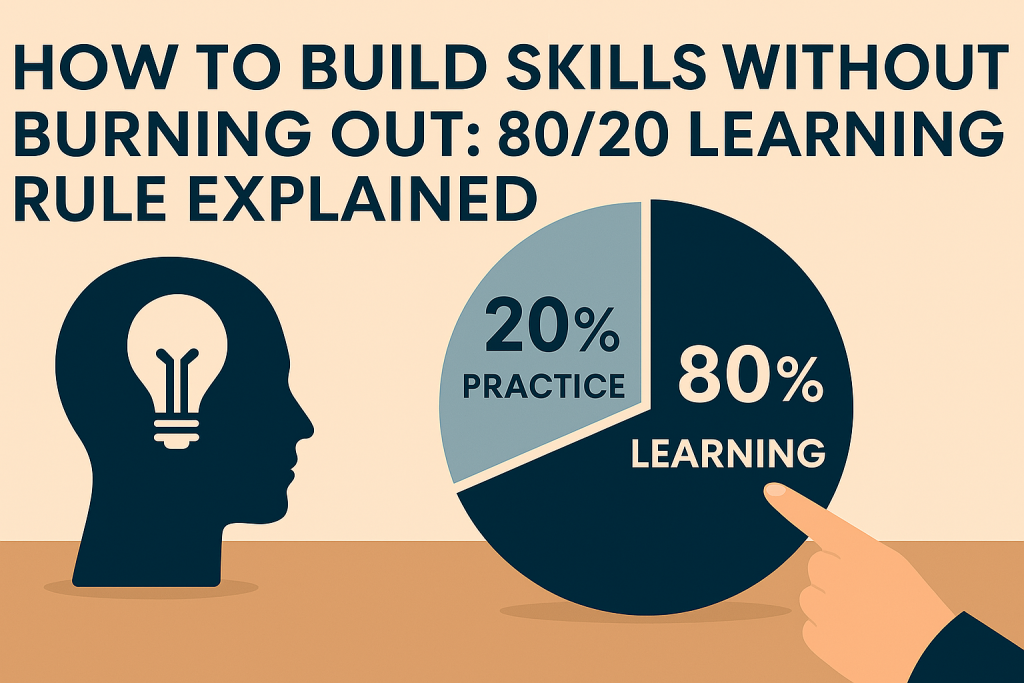
The 80/20 rule is simple: 80% of your results come from 20% of your efforts.
This idea started with an Italian economist named Vilfredo Pareto in 1896. He noticed that 80% of Italy’s wealth belonged to 20% of the people. Then he looked at his garden and saw that 80% of his peas came from 20% of his plants.
This pattern shows up everywhere:
- 80% of company profits come from 20% of customers
- 80% of complaints come from 20% of problems
- 80% of your clothes get worn 20% of the time
- 80% of results at work come from 20% of tasks
The numbers don’t have to be exact. Sometimes it’s 70/30 or 90/10. The key point is this: a small portion of what you do creates most of your success.
Applying the 80/20 Rule to Skill Building
Here’s how to use this powerful principle to learn any skill without burning out:
1. Identify the Vital 20%
Before you start learning, ask yourself: “What are the core parts that will give me the biggest results?”
For coding, this might be:
- Understanding basic syntax and logic
- Learning how to debug errors
- Practicing with real projects
For learning Spanish, focus on:
- The 1,000 most common words (they make up 80% of conversations)
- Basic grammar patterns
- Listening to native speakers
For Excel skills at work:
- Formulas like SUM, VLOOKUP, and IF statements
- Creating charts and graphs
- Data filtering and sorting
The trick is to research what experts consider essential. Look for “fundamentals” or “core concepts” in any field. Ask people who are already good at the skill what they use most often.
2. Prioritize Effective Learning Methods
Not all study methods are equal. Some give you much better results for the same time investment.
Active recall beats passive reading every time. Instead of highlighting textbooks, test yourself. Cover up definitions and try to remember them. Explain concepts out loud.
Spaced repetition helps you remember longer. Review new information after one day, then three days, then a week, then a month. This prevents forgetting better than cramming.
Practice testing shows you what you really know. Take practice exams, do sample problems, or teach someone else. Testing reveals gaps in your knowledge that reading can’t show.
3. Set Realistic and Focused Goals
Big goals feel overwhelming. Small goals build momentum.
Instead of “Learn Python,” try “Write a simple calculator program this week.” Instead of “Become fluent in French,” aim for “Have a five-minute conversation about hobbies.”
Break every skill into chunks you can finish in 1-2 weeks. Each small win gives you confidence and energy to keep going. Success breeds success.
Write down your goals and track your progress. Seeing improvement motivates you to continue.
4. Avoid Overloading on the Trivial 80%
Here’s the hard truth: most learning materials include a lot of fluff. Textbooks cover everything, but you don’t need everything to get started.
When learning guitar, you don’t need to know music theory to play your first song. When learning to cook, you don’t need to understand the chemistry of baking to make a good pasta dish.
Focus on what you need right now to reach your next goal. Save the advanced stuff for later. This prevents information overload and keeps you moving forward.
Set time limits for research. Give yourself 30 minutes to find the best resources, then start practicing. Don’t spend three hours reading about the “perfect” method.
5. Regularly Reflect and Adjust
Every week, ask yourself these questions:
- What’s working well for me?
- What’s not helping?
- Where am I getting stuck?
- What should I change next week?
Keep a simple learning journal. Write down what you practiced, what you learned, and how you felt. This helps you spot patterns and improve your approach.
If something isn’t working after two weeks, try a different method. Maybe you learn better from videos than books, or from doing rather than reading.
Benefits of the 80/20 Learning Approach
When you apply the 80/20 rule to learning, you’ll notice several powerful benefits:
Increased efficiency: You spend your time on what matters most. No more wasted hours on minor details that don’t help you reach your goals.
Less burnout: Focusing on key concepts prevents overwhelm. You make steady progress without exhausting yourself.
Higher motivation: Quick wins from focusing on high-impact areas keep you excited about learning. You see results faster, which encourages you to continue.
Smarter time use: You get better results in less time. This leaves room for other important things in your life.
Quicker mastery: By mastering the fundamentals first, you build a strong foundation. Advanced concepts become easier to understand later.
Practical Example: Learning History for an Exam
Let’s see how this works in real life. Imagine you have two weeks to prepare for a history exam about World War II.
Traditional approach: Read the entire textbook, take notes on every chapter, memorize dates and names, study everything equally.
80/20 approach:
- Identify the vital 20%: Ask what topics appear most on past exams. Focus on major battles, key leaders, and important turning points.
- Use effective methods: Create timeline flashcards, practice with past exam questions, explain major events to a friend.
- Set focused goals: Master one major topic per day (D-Day, Pearl Harbor, Holocaust, etc.).
- Avoid trivial details: Skip minor dates and obscure facts that rarely appear on tests.
- Reflect and adjust: After three days, see which study methods help you remember best.
The result? You know the important material well instead of knowing everything poorly. You feel confident instead of overwhelmed.
Common Mistakes to Avoid
Skipping fundamentals: Don’t jump to advanced topics just because they seem more interesting. Master the basics first.
Over-optimizing too early: Don’t spend weeks planning the perfect learning system. Start with good enough and improve as you go.
Ignoring feedback: If you’re not making progress, something needs to change. Don’t keep doing what doesn’t work.
Perfectionism: You don’t need to master everything before moving forward. Good enough is often good enough.
Comparing yourself to others: Everyone learns differently. Focus on your own progress, not someone else’s speed.
Final Tips for Sustainable Skill Building
Learn in sprints, not marathons: Study intensely for 25-45 minutes, then take a break. This prevents mental fatigue and keeps you sharp.
Track what’s working: Keep notes about which methods help you learn best. Use more of what works and less of what doesn’t.
Use breaks and rewards: Celebrate small wins. Take a walk after a good study session. Watch a movie after reaching a weekly goal.
Stay consistent: Thirty minutes every day beats four hours once a week. Regular practice builds habits and prevents forgetting.
Find your peak times: Some people learn best in the morning, others at night. Schedule your most important learning during your peak energy hours.
Recommended Resources
Books:
- “The 80/20 Principle” by Richard Koch – Deep dive into applying this rule to all areas of life
- “Make It Stick” by Peter Brown – Science-based learning techniques that actually work
Apps:
- Anki – Spaced repetition flashcards for memorization
- Forest – Timer app that helps you stay focused during study sessions
Websites:
- Khan Academy – Free courses that focus on core concepts in many subjects
- Coursera – University courses that often highlight the most important material
Techniques:
- Pomodoro Technique – 25-minute focused work sessions with breaks
- Feynman Technique – Explain concepts in simple terms to test your understanding
Conclusion
The 80/20 rule changes everything about how we learn. Instead of trying to absorb everything, we focus on what matters most. Instead of burning out, we build sustainable habits that last.
Remember: 20% of what you learn will create 80% of your results. Your job is to find that crucial 20% and give it your best effort.
This approach isn’t about being lazy or cutting corners. It’s about being smart with your time and energy. It’s about working with your brain, not against it.
The next time you want to build a new skill, start by asking: “What’s the 20% that will give me 80% of the results?” Then focus there first.
Your future self will thank you for learning smarter, not harder.
Ready to get started? Try identifying your 20% today!