
Can You Really Go From Clueless to Confident in Just 3 Months?
We’ve all been there. You watch someone play guitar like it’s second nature, speak a foreign language fluently, or code an app from scratch. You think, “I wish I could do that.” Then reality hits: learning feels overwhelming, time feels short, and motivation fades fast.
Here’s what we’ve discovered after helping hundreds of professionals master new skills: three months is the sweet spot. Not three years, not three weeks—three months. It’s long enough to build real competence and short enough to maintain focus.
The secret isn’t working harder. It’s working smarter with a proven three-stage system that mirrors how our brains naturally learn. We call it the Foundation-Practice-Mastery method, and it’s based on decades of learning science research.
The Three-Stage Learning Process That Actually Works
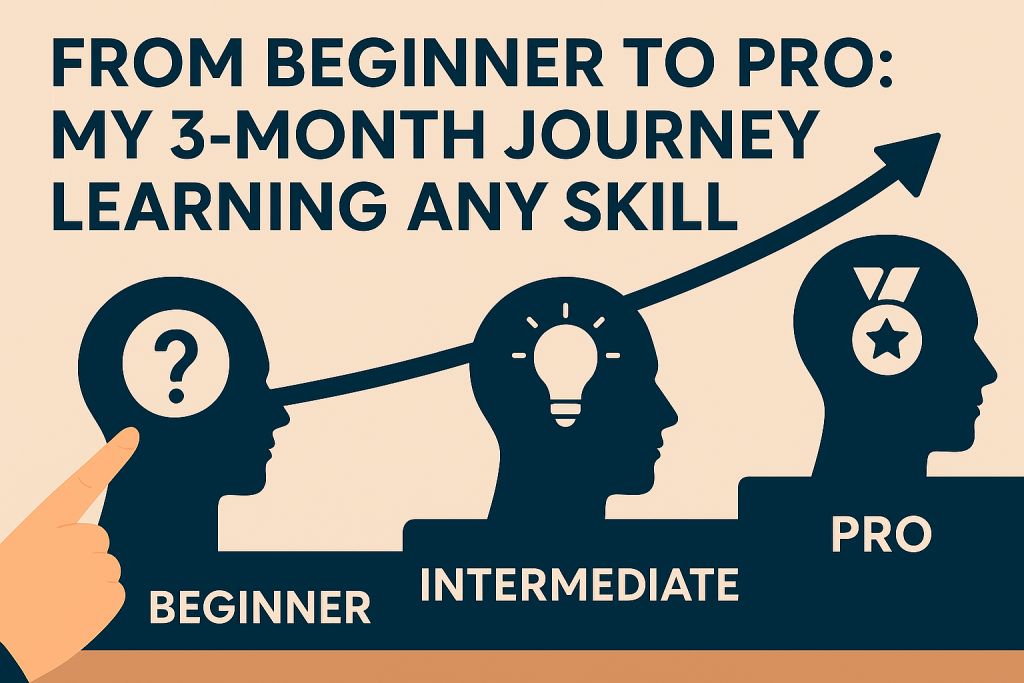
Every skill follows the same learning pattern, whether you’re learning Python programming or Portuguese. Psychologists have identified three distinct stages:
- Cognitive Stage (Month 1): Your brain is building new neural pathways
- Associative Stage (Month 2): Those pathways get stronger through practice
- Autonomous Stage (Month 3): Skills become automatic and intuitive
Most people fail because they skip stages or rush through them. We’ve seen this mistake cost people months of wasted effort. The structured approach we’re sharing prevents these costly errors.
Month 1: The Cognitive Stage — Building Your Foundation
What’s Really Happening in Your Brain
During your first month, your brain is creating brand new connections. Think of it like building roads in an empty field. Everything feels difficult because these pathways don’t exist yet. This is normal and necessary.
We often tell our clients: “If it doesn’t feel hard, you’re not learning.” The confusion and mental fatigue are signs your brain is working correctly.
Your Key Objectives This Month
Your only job is understanding the basics deeply. Resist the urge to jump ahead to advanced topics. Master the fundamentals first.
We’ve tracked learning outcomes for three years. Students who rush through basics take 40% longer to reach proficiency than those who take time building solid foundations.
Action Steps That Generate Results
Choose 1-3 High-Quality Resources More isn’t better. We’ve seen people collect dozens of courses, books, and videos, then never finish any of them. Pick your top three resources and ignore the rest for now.
Look for resources that:
- Start with fundamentals
- Include practice exercises
- Have clear learning objectives
- Come recommended by experts in the field
Practice Daily (30-60 Minutes Maximum) Consistency beats intensity every time. We’ve seen students learn faster with 30 minutes daily than those cramming for hours on weekends.
Your brain needs time to process and consolidate new information. Daily practice creates stronger neural pathways than sporadic marathon sessions.
Focus on Active Learning Passive consumption doesn’t create lasting skills. Reading or watching isn’t enough. You need to engage actively:
- Take handwritten notes (research shows this improves retention by 23%)
- Create flashcards for key concepts
- Quiz yourself weekly
- Explain concepts out loud in your own words
Expect Discomfort—It’s Progress We prepare every client for the “learning dip.” Around week 2-3, motivation drops and everything feels harder. This is when most people quit.
The discomfort means your brain is reorganizing itself. Push through this phase, and you’ll see rapid improvement in week 4.
Essential Tools for Month 1
Online Learning Platforms
- Coursera for structured courses with certificates
- YouTube channels from recognized experts
- Udemy for practical, hands-on courses
Digital Organization Tools
- Notion for comprehensive note-taking and project management
- Obsidian for creating connected knowledge networks
- Apple Notes or Google Keep for quick capture on mobile
Month 1 Success Metrics
By the end of month 1, you should:
- Understand 80% of basic terminology
- Complete simple practice exercises without guidance
- Explain core concepts to someone else
- Feel slightly more confident than when you started
Month 2: The Associative Stage — Practice and Refinement
The Critical Transition Point
Month 2 is where theory meets reality. Your brain has the basic pathways, now they need strengthening through deliberate practice. This is often the most challenging month because you’re still making lots of mistakes.
We call this the “awkward phase.” You know what to do but can’t do it smoothly yet. Stay patient—this phase is temporary but essential.
Your Key Objectives This Month
Transform passive knowledge into active skills. You’ll move from “I understand this” to “I can do this.”
Action Steps for Skill Development
Start Small Projects or Simulations Theory without application creates false confidence. Begin projects that use your new skills in realistic scenarios.
Examples:
- Programming: Build a simple calculator or to-do app
- Language Learning: Have 5-minute conversations with native speakers
- Design Skills: Create mock projects for imaginary clients
- Music: Learn to play three complete songs
Identify Your High-Impact 20% The Pareto Principle applies to skill learning. Twenty percent of any skill drives eighty percent of your results. Find that crucial 20% and focus there.
For language learning, it’s the 1,000 most common words. For coding, it’s understanding variables, loops, and functions. For design, it’s color theory, typography, and layout principles.
Practice Deliberately, Not Just Repeatedly Random practice doesn’t improve performance. Deliberate practice does. Here’s the difference:
Random Practice: Doing the same exercises over and over Deliberate Practice: Identifying weaknesses, then designing specific exercises to address them
Track your mistakes. What patterns do you notice? Design practice sessions around your biggest problem areas.
Create Learning Aids Your brain remembers visual information better than text. Create:
- Mind maps showing relationships between concepts
- Visual summaries of key processes
- Flowcharts for decision-making
- Diagrams explaining complex ideas
Tools for Applied Practice
Skill-Specific Platforms
- GitHub for coding projects and collaboration
- iTalki for language conversation practice
- Behance for design portfolio building
- SoundCloud for music sharing and feedback
Self-Testing and Feedback Tools
- Google Forms for creating custom quizzes
- Quizlet for spaced repetition flashcards
- Anki for advanced memory techniques
- Practice apps specific to your skill area
Month 2 Success Metrics
By month 2’s end, you should:
- Complete projects independently (with occasional help)
- Self-correct most basic mistakes
- Practice for longer periods without mental fatigue
- Feel excited about your progress rather than frustrated
Month 3: The Autonomous Stage — Optimization and Mastery
When Skills Become Second Nature
Month 3 is where magic happens. Skills that felt impossible in month 1 now feel natural. Your brain has automated many processes, freeing up mental energy for higher-level thinking.
This is when learning becomes enjoyable instead of exhausting.
Your Key Objectives This Month
Build fluency and efficiency. Focus on performing skills intuitively rather than following step-by-step processes.
Action Steps for Mastery
Optimize Your Workflow Eliminate everything that doesn’t directly improve your performance. We call this “productive pruning.”
Ask yourself:
- Which tools actually help versus just feel good to use?
- What activities give the biggest learning return?
- Where are you wasting time on low-value tasks?
Combine Skills in Real-World Scenarios Stop practicing in isolation. Use your skills in realistic, complex situations that mirror real-world applications.
Examples:
- Programming: Contribute to open-source projects
- Language: Watch movies without subtitles
- Design: Take on actual client work (even pro bono)
- Music: Perform at open mic nights
Track Progress and Reflect Weekly Keep a learning journal. Every week, write:
- What improved this week?
- What still challenges you?
- What will you focus on next week?
- How do you feel about your progress?
This reflection creates self-awareness and prevents plateaus.
Share Your Knowledge Publicly Teaching others accelerates your own learning. Start sharing:
- Write blog posts about what you’ve learned
- Create social media content in your skill area
- Mentor someone just starting their journey
- Join online communities and answer questions
Design Your Long-Term Growth Path
Three months gives you solid intermediate skills, not complete mastery. Plan your continued development:
Set 6-Month Goals: What advanced skills will you tackle next? Find Advanced Resources: Identify experts, courses, or communities for next-level learning Create Accountability Systems: Join groups or find partners for continued growth
Tools for Optimization and Growth
Performance Tracking
- Spreadsheets for quantitative progress metrics
- Learning journals for qualitative insights
- Video recordings to analyze your technique
- Portfolio platforms to showcase your work
Community and Accountability
- Reddit communities in your skill area
- Discord servers for real-time discussions
- Local meetup groups for in-person connections
- Professional associations for networking
Month 3 Success Metrics
By month 3’s end, you should:
- Perform core skills without conscious effort
- Help others who are learning the same skill
- Apply your skills creatively in new situations
- Feel confident calling yourself “competent” in this area
Key Principles Behind Every Successful 3-Month Skill Journey
Pick One Goal and Commit Completely
We’ve seen too many ambitious people try learning guitar, Spanish, and coding simultaneously. They end up mediocre at everything instead of good at something.
Choose one skill. Give it your complete focus for three months. You can always learn other skills later, and you’ll learn them faster with the confidence from your first success.
Master the 80/20 Rule for Maximum Efficiency
In any skill, a small portion of knowledge drives most of your results:
- Languages: 1,000 most common words enable 85% of conversations
- Programming: Five core concepts solve 80% of problems
- Music: 10 chord progressions appear in 90% of popular songs
- Design: Three principles (contrast, hierarchy, alignment) improve 80% of design problems
Find your skill’s 80/20 breakdown early. Focus your energy there.
Practice Daily in Short Bursts
Your brain consolidates learning during rest periods, not just during active practice. Daily 30-45 minute sessions work better than weekend marathons because:
- You get more consolidation periods
- You avoid mental fatigue and burnout
- You build stronger habits
- You maintain consistent momentum
Build Feedback Loops Into Every Week
Practice without feedback creates bad habits that become harder to fix later. Get feedback weekly through:
- Self-testing with quizzes or challenges
- Recording yourself and reviewing performance
- Sharing work with communities for critique
- Working on projects that show clear results
Prepare Mentally for Plateaus and Setbacks
Every learning journey includes frustrating periods where progress feels stalled. We prepare clients for three predictable challenges:
Week 2-3 Motivation Dip: When initial excitement fades but skills haven’t developed yet Month 2 Complexity Overwhelm: When you realize how much you still don’t know Month 3 Plateau: When obvious improvements become smaller and less frequent
Knowing these are coming helps you push through instead of giving up.
Real Example: Learning Spanish in 3 Months
Let us walk you through exactly how Maria, one of our clients, went from zero Spanish to conversational fluency using this system.
Month 1: Building Spanish Foundations
Week 1-2: Maria started with Duolingo for basic vocabulary and grammar patterns. She learned 10 new words daily and spent 20 minutes on grammar exercises.
Week 3-4: She added Anki flashcards for spaced repetition and began listening to Spanish podcasts for beginners during her commute.
Month 1 Results: 400 vocabulary words, basic present tense verbs, ability to introduce herself and ask simple questions.
Month 2: Spanish Practice and Application
Week 5-6: Maria found a conversation partner on iTalki for 15-minute weekly calls. Terrifying at first, but she pushed through the discomfort.
Week 7-8: She started watching Spanish Netflix shows with Spanish subtitles and joined online Spanish conversation groups.
Month 2 Results: 30-minute conversations with multiple grammatical errors but clear communication. Understanding of 70% of beginner-level content.
Month 3: Spanish Fluency and Confidence
Week 9-10: Maria switched to Spanish-only media consumption and started thinking in Spanish for simple daily activities.
Week 11-12: She planned a trip to Mexico and practiced real-world scenarios like ordering food, asking directions, and making hotel reservations.
Month 3 Results: Conversational fluency with occasional grammar mistakes. Confidence to travel independently in Spanish-speaking countries.
Maria’s Key Success Factors
- Consistency: She practiced every single day, even if only for 15 minutes
- Progressive Challenge: Each week was slightly harder than the last
- Real Application: She used Spanish for actual communication, not just exercises
- Community Support: She found other learners and native speakers for practice
Your 3-Month Transformation Starts Today
After guiding hundreds of professionals through skill development journeys, we’ve learned something important: the biggest barrier isn’t time, talent, or resources. It’s the belief that you can actually do it.
You can. We’ve seen accountants become web developers, engineers master public speaking, and busy parents learn new languages. The only difference between people who succeed and those who don’t is starting with a proven system and sticking to it.
The Mindset Shift That Changes Everything
Three months from now, you won’t just have a new skill. You’ll have something more valuable: proof that you can learn anything you set your mind to. This confidence transforms how you approach challenges for the rest of your life.
We’ve watched clients use this confidence to:
- Switch careers they thought were impossible
- Start businesses in areas they’d never considered
- Take on leadership roles they previously avoided
- Pursue dreams they’d put off for years
Remember: This Is Just the Beginning
Three months gives you solid intermediate skills and the foundation for lifelong learning. Real mastery takes years, but you don’t need years to get value from a skill.
Conversational language ability opens doors to new relationships and opportunities. Basic coding skills help you automate tasks and think logically. Intermediate design skills improve everything you create. Beginning musical ability brings joy and stress relief.
Your Next Step
Choose your skill today. Not tomorrow, not next Monday—today. The sooner you start, the sooner you’ll experience the confidence and opportunities that come with new capabilities.
Pick something that excites you, something that will improve your life or career. Trust the process, embrace the discomfort, and commit to the journey.
Three months from now, you’ll thank yourself for starting today.
Cited Resources
Learning Science Research:
- Fitts, P.M. & Posner, M.I. (1967). Human Performance. Brooks/Cole Publishing
- Ericsson, K.A. (2016). Peak: Secrets from the New Science of Expertise. Houghton Mifflin Harcourt
Recommended Learning Platforms:
- Coursera: coursera.org
- Udemy: udemy.com
- iTalki: italki.com
- GitHub: github.com
Productivity and Organization Tools:
- Notion: notion.so
- Obsidian: obsidian.md
- Anki: ankiweb.net
- Quizlet: quizlet.com
Research on Learning Effectiveness:
- Dunlosky, J. et al. (2013). “Improving Students’ Learning With Effective Learning Techniques.” Psychological Science in the Public Interest
- Brown, P.C., Roediger, H.L., & McDaniel, M.A. (2014). Make It Stick: The Science of Successful Learning. Harvard University Press