
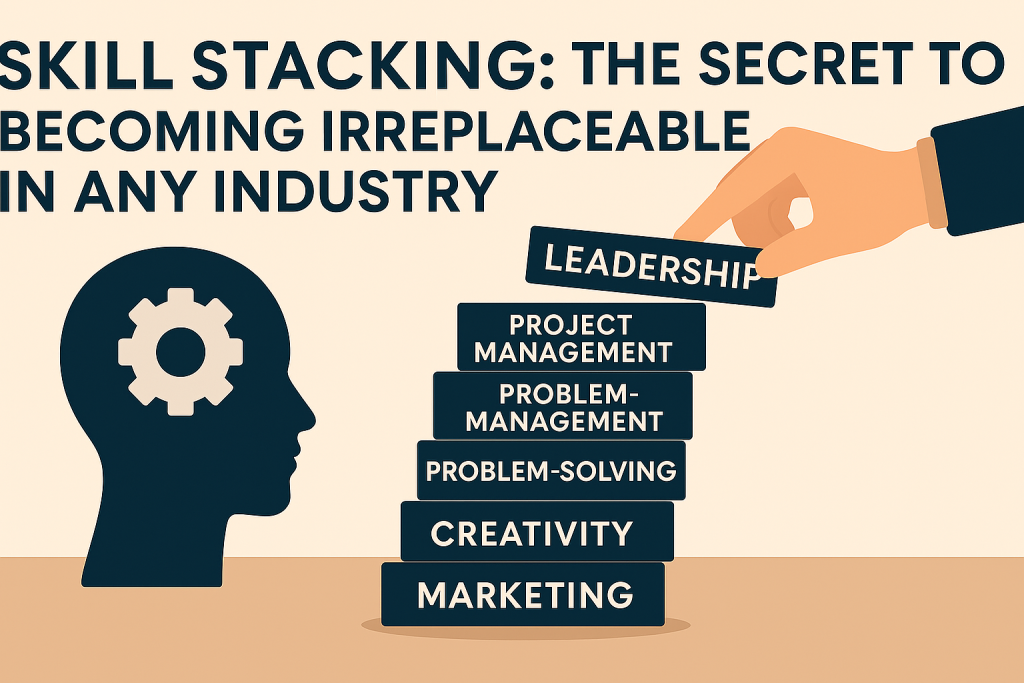
Most people think they need to pick one thing and become the best at it. We’re told to specialize, focus, and go deep. But here’s what we’ve learned after working with thousands of professionals: the people who truly stand out don’t just master one skill—they master the art of combining skills in ways nobody else does.
This approach is called skill stacking. Instead of being the best copywriter in your company, you become the copywriter who also understands data analysis and psychology. Instead of being just another project manager, you become the project manager who can also design and code.
When you stack skills this way, you don’t just add to your abilities—you multiply them. You become the person others can’t replace because nobody else has your exact combination of talents.
What Is Skill Stacking?
Skill stacking means deliberately building a collection of related skills that work together to create something unique. Think of it like a signature recipe. Anyone can make pasta, and anyone can make sauce. But when you combine specific ingredients in your own special way, you create something that belongs only to you.
This approach is different from what most people do. A generalist knows a little about everything but isn’t great at anything. A specialist knows everything about one thing but struggles when that thing becomes less important. A skill stacker picks 3-5 skills that work well together and becomes really good at all of them.
Scott Adams, the creator of Dilbert, explains it perfectly. He’s not the world’s best artist, and he’s not the world’s funniest writer. But he’s probably the only person who’s really good at both drawing and writing workplace humor. That combination made him millions of dollars and gave him a career that’s lasted decades.
Elon Musk shows us skill stacking on a bigger scale. He combines engineering knowledge, business strategy, marketing instincts, and leadership skills. No single skill makes him special, but the combination makes him nearly impossible to replace.
Why Skill Stacking Makes You Irreplaceable
1. Unique Value Creation
When you stack skills, you solve problems other people can’t even see. A marketing manager who also understands data science doesn’t just run campaigns—they predict which campaigns will work before spending money. A teacher who knows video editing doesn’t just teach lessons—they create learning experiences that students remember for years.
Sarah from our client base learned this firsthand. As a financial analyst, she was good but replaceable. Then she learned user experience design. Now she creates financial dashboards that people actually want to use. Her company promoted her to lead a new team because nobody else could do what she does.
2. Enhanced Employability Across Roles
Most job postings today ask for multiple skills. They want marketers who understand analytics, designers who can code, and managers who know technology. When you have a skill stack, you qualify for jobs that most people can’t even apply for.
We’ve seen this with Tom, a graphic designer who learned basic coding. He went from competing with thousands of designers for $40,000 jobs to being one of 50 candidates for $80,000 user interface positions. Same person, bigger opportunities.
3. Career Mobility & Leadership Potential
Leaders need to understand multiple areas of business. When you have skills in different departments, you can communicate with everyone and see the big picture. Companies promote people who can bridge gaps between teams.
Maria started as a customer service representative. She learned sales techniques and data analysis. Within three years, she became head of customer experience because she understood both the human side and the numbers side of customer relationships.
4. Resilience in Uncertain Job Markets
When industries change or jobs disappear, people with skill stacks adapt faster. If one of your skills becomes less valuable, your other skills keep you employed while you develop new ones.
During the 2020 pandemic, restaurants couldn’t serve customers in person. The restaurant managers who survived were those who had also learned digital marketing, online ordering systems, or delivery logistics. Their extra skills saved their careers.
5. Exponential Impact (1+1=3 Effect)
This is where skill stacking gets exciting. When you combine skills, you don’t just add their value—you multiply it. A salesperson who understands psychology doesn’t just sell 20% more. They often sell 200% more because they understand why people really buy things.
Jake combined his accounting background with social media skills. He didn’t become a slightly better accountant—he became the go-to person for small businesses who need both bookkeeping and online marketing. His income tripled in two years.
6. Personal Brand Power
When you have a unique skill combination, people remember you. You become “the person who does X and Y.” This makes networking easier, referrals more common, and opportunities come to you instead of you chasing them.
Think about the professionals you remember most. They’re probably not the ones who do just one thing really well. They’re the ones who combine skills in interesting ways that stick in your mind.
How to Start Building Your Skill Stack
1. Identify Your Core Skills
Start by figuring out what you’re already good at. Spend 30 minutes writing down everything you know how to do. Include work skills, hobbies, and things you learned in school.
Ask yourself: What do coworkers ask for my help with? What part of my job feels easy while others struggle? What compliments do I get most often?
Get feedback from people who know your work. Sometimes we don’t see our own strengths clearly. Your core skills are the foundation of your stack, so identify them correctly.
2. Choose Complementary Skills Strategically
Look for skills that enhance what you already do well. If you’re good with people, learn skills that let you reach more people or understand them better. If you’re analytical, learn skills that let you gather better data or present findings more clearly.
Think in these categories:
- Technical skills: Software, tools, systems that make your work faster or better
- Communication skills: Writing, speaking, presenting that help you share your expertise
- Creative skills: Design, video, storytelling that make your work more engaging
- Business skills: Strategy, finance, project management that help you think bigger
Use the T-shaped model: Go deep in one area (the vertical line) and wide in related areas (the horizontal line). This gives you expertise plus versatility.
3. Look for Uncommon Skill Combinations
The magic happens when you combine skills that don’t usually go together. Most accountants don’t learn design. Most designers don’t learn data analysis. Most writers don’t learn programming.
Look for intersections where two fields meet but few people work. These spots have less competition and more opportunity. A fitness trainer who learns nutrition counseling isn’t special. A fitness trainer who learns app development can create the next big fitness platform.
4. Integrate and Apply Skills in Real Projects
Don’t just learn skills—use them together. Create projects that require multiple skills from your stack. This shows you how the skills connect and gives you proof of what you can do.
Lisa learned graphic design and copywriting separately. Then she created a complete marketing campaign for a local business, doing both the design and the writing. That project led to three more clients who needed someone who could handle both parts of their marketing.
Start small. If you’re learning coding and marketing, build a simple website for a friend’s business. If you’re learning writing and video editing, create a short documentary about something you care about. These projects become your portfolio and your learning laboratory.
5. Commit to Lifelong Learning
Skill stacking never ends. Technology changes, industries evolve, and new opportunities appear. Plan to add one new skill to your stack every year.
Use resources that fit your learning style:
- Online courses: Coursera, Udemy, and LinkedIn Learning for structured learning
- YouTube: Free tutorials for almost any skill you can imagine
- Books: Deep knowledge that courses sometimes skip
- Practice projects: Real work that forces you to use what you learn
- Mentors: People who’ve combined skills successfully
The key is consistency, not speed. Spend 30 minutes a day learning, and you’ll master a new skill every 6-12 months.
Real-World Examples of Skill Stacking
The Science Communicator: Dr. Amanda’s Story
Dr. Amanda had a PhD in environmental science but struggled to get her research funded. She learned digital marketing and video editing. Now she creates YouTube videos that explain climate science in simple terms.
Her skill stack (scientific expertise + communication + video production) landed her consulting contracts with green energy companies, speaking engagements at conferences, and a book deal. She earns more than most university professors while doing work she loves.
The Data-Driven Designer: Marcus’s Journey
Marcus was a graphic designer competing with thousands of others for the same jobs. He learned data analysis and user research methods. Now he doesn’t just make things look good—he makes things that perform well.
His designs increase conversion rates because he understands user behavior. Clients pay him three times what they pay regular designers because his work makes them money. His skill stack (design + data + psychology) created a unique market position.
The Educator Entrepreneur: Jennifer’s Transformation
Jennifer taught high school math for 10 years. She learned content creation, video editing, and online business. During the pandemic, she created online math courses that help students who struggle with traditional teaching methods.
Her teaching experience gives her content credibility. Her video skills make her courses engaging. Her business knowledge helps her market effectively. She now earns more from her online courses than she did teaching, while helping students worldwide.
Key Benefits at a Glance
| Benefit | Description | Your Advantage |
|---|---|---|
| Market Differentiation | Stand out from others with similar backgrounds | Become the obvious choice for complex projects |
| Career Flexibility | Qualify for roles in multiple departments | Switch directions without starting over |
| Earning Power | Command higher salaries for rare skill combinations | Get paid for being irreplaceable |
| Brand Identity | Be known for something specific and valuable | Attract opportunities instead of chasing them |
| Resilience | Adapt when industries or jobs change | Stay employed while others struggle |
| Leadership Potential | Understand multiple aspects of business | Get promoted to positions that require broad knowledge |
Recommended Resources for Building Your Stack
Core Skill Development
- Books: “The First 20 Hours” by Josh Kaufman for learning any skill quickly
- Courses: LinkedIn Learning paths for business skills
- Practice: Volunteer for projects that stretch your abilities
Technical Skills
- Coding: FreeCodeCamp for web development basics
- Data Analysis: Google Analytics Academy for marketing data
- Design: Canva Design School for non-designers
Communication Skills
- Writing: Grammarly Blog for clear communication
- Speaking: Toastmasters International for presentation skills
- Video: Creator Economy Report for content creation trends
Creative Skills
- Photography: YouTube channels like Peter McKinnon
- Video Editing: DaVinci Resolve (free software) tutorials
- Storytelling: “Made to Stick” by Chip and Dan Heath
Business Skills
- Strategy: Harvard Business Review for industry insights
- Project Management: Google Project Management Certificate
- Finance: Khan Academy for business finance basics
Start with one resource from each category. Master it before moving to the next. Quality beats quantity when building your stack.
Your Next Steps
Skill stacking isn’t just a career strategy—it’s your secret weapon for the modern economy. While others compete on single skills, you’ll compete on combinations that nobody else has.
The professionals who thrive in the coming years won’t be those who know the most about one thing. They’ll be those who know enough about several things to create unique value.
Your skill stack starts with one small addition. Pick one skill that complements what you already do well. Spend 30 minutes today learning something new. Tomorrow, spend another 30 minutes. In six months, you’ll have a skill that makes you more valuable. In two years, you’ll have a combination that makes you irreplaceable.
The future belongs to skill stackers. Your stack starts now.