
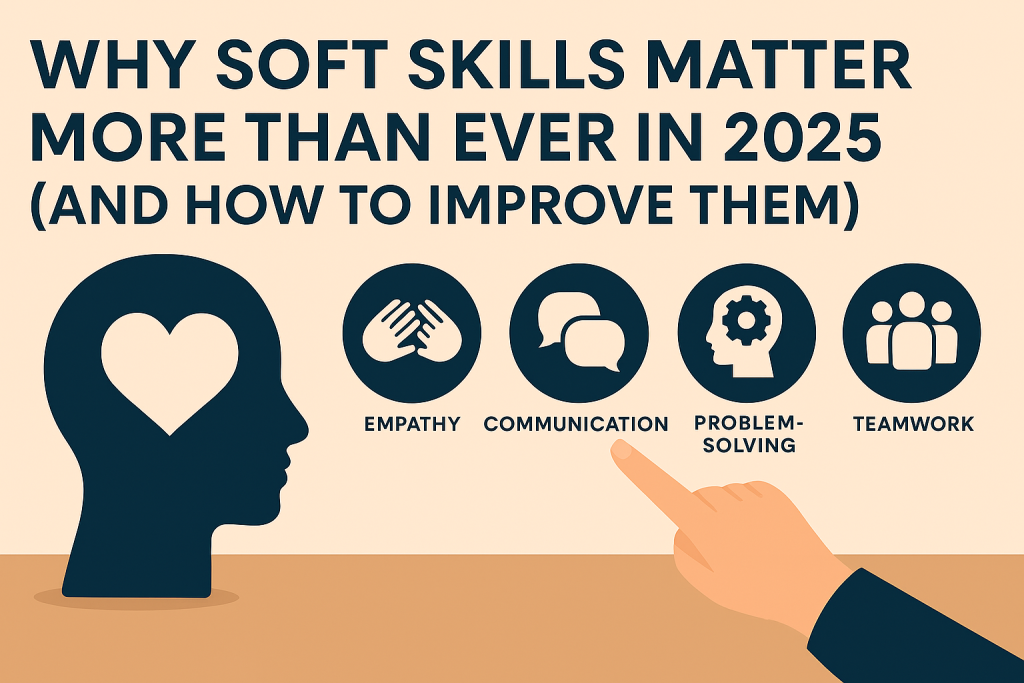
We live in a world where machines can write code, analyze data, and even create art. Yet, the most successful professionals we work with share one common trait: exceptional soft skills. These human abilities—like communication, empathy, and problem-solving—have become the bridge between technological capability and real-world success.
Soft skills are the personal qualities that help us work well with others. They include how we communicate, solve problems, adapt to change, and lead teams. Unlike technical skills that focus on specific tools or knowledge, soft skills shape how we interact with people and handle workplace challenges.
In 2025, we’re seeing a remarkable shift. While technology handles routine tasks, employers desperately need people who can think critically, collaborate effectively, and navigate complex human relationships. This blog explores why soft skills have become non-negotiable in today’s job market and provides practical strategies to strengthen these essential abilities.
Why Soft Skills Matter More Than Ever in 2025
Soft Skills as a Hiring Priority
The numbers tell a compelling story. Recent surveys show that 89% of hiring managers struggle to find candidates with strong soft skills. Meanwhile, 57% of senior leaders say soft skills are more important than hard skills when evaluating potential hires.
We’ve witnessed this firsthand across industries. Tech companies seek engineers who can explain complex concepts to non-technical teams. Healthcare organizations prioritize nurses who demonstrate compassion alongside clinical expertise. Financial firms value advisors who build trust through genuine communication rather than just product knowledge.
This trend spans every sector because employers recognize a fundamental truth: technical skills can be taught relatively quickly, but soft skills require time, practice, and genuine commitment to develop.
Navigating Change with Adaptability
Change happens faster now than ever before. New technologies emerge monthly. Industry practices evolve continuously. Market conditions shift without warning. In this environment, adaptability isn’t just helpful—it’s essential for survival.
We see professionals thrive when they embrace change rather than resist it. Those with strong soft skills view disruption as opportunity. They ask questions instead of making assumptions. They seek solutions rather than dwelling on problems. They remain curious when others become overwhelmed.
Resilience plays a crucial role here. The ability to bounce back from setbacks, learn from failures, and maintain focus during uncertainty separates high performers from those who struggle with change.
Elevating Human-Centered Customer Experiences
Customers today expect more than efficient service—they want meaningful connections. Emotional intelligence drives these connections. When customer service representatives truly understand and respond to emotions, satisfaction scores improve dramatically.
We’ve observed businesses transform their customer relationships by investing in empathy training. Sales teams who listen actively and respond authentically build stronger client partnerships. Support staff who demonstrate genuine concern resolve issues more effectively and create loyal customers.
This human touch becomes even more valuable as automated systems handle basic interactions. Customers appreciate the expertise and emotional understanding that only humans can provide.
Remote Work & Diverse Teams Need Strong Communicators
Hybrid work models have redefined collaboration. Success now depends on clear communication across time zones, cultures, and communication styles. We work with teams spanning continents, bringing together diverse perspectives and approaches.
Strong communicators excel in this environment. They adapt their message for different audiences. They ask clarifying questions to prevent misunderstandings. They recognize cultural differences and adjust their approach accordingly.
Conflict resolution skills have become particularly valuable. When team members can’t read body language or share casual conversations, minor disagreements can escalate quickly. Professionals who navigate these challenges diplomatically keep projects moving forward.
Bridging the Human-Tech Divide
Technology amplifies human capability but cannot replace human judgment. We see this daily in our consulting work. Data analysis tools provide insights, but humans must interpret what those insights mean for business strategy. Automation handles routine tasks, but humans decide which tasks deserve attention.
Leadership remains fundamentally human. While systems can track performance metrics, leaders must inspire teams, make difficult decisions, and guide organizations through uncertainty. Creativity and innovation emerge from human imagination, not algorithmic processing.
The most successful professionals we know use technology as a powerful tool while maintaining focus on human relationships and creative problem-solving.
Soft Skills Drive Team and Organizational Performance
Organizations with strong soft skills cultures consistently outperform their competitors. Teams communicate more effectively, collaborate more naturally, and innovate more frequently. Employee satisfaction increases, turnover decreases, and productivity improves measurably.
We’ve documented significant improvements in organizations that prioritize soft skills development. Project completion rates increase when team members communicate clearly and support each other. Innovation flourishes when diverse perspectives are welcomed and valued. Customer satisfaction improves when employees demonstrate genuine care and understanding.
Top Soft Skills Dominating 2025
Based on our research and client feedback, these soft skills represent the most valuable capabilities in today’s workplace:
Critical Thinking and Problem-Solving – The ability to analyze situations objectively and develop effective solutions
Emotional Intelligence (EQ) – Understanding and managing your emotions while recognizing and responding to others’ feelings
Adaptability and Resilience – Flexibility in changing circumstances and the strength to recover from challenges
Collaboration and Teamwork – Working effectively with diverse groups to achieve common goals
Communication Skills – Expressing ideas clearly and listening actively across different formats and audiences
Leadership and Decision-Making – Guiding others and making sound choices under pressure
Creativity and Innovation – Generating original ideas and approaches to solve problems or improve processes
Each skill reinforces the others. Strong communicators often demonstrate emotional intelligence. Resilient individuals typically show adaptability. Creative thinkers frequently excel at problem-solving. Developing these skills together creates a powerful professional foundation.
How to Improve Your Soft Skills in 2025
Seek Feedback and Reflect
Growth begins with honest self-assessment. We encourage professionals to actively seek feedback from colleagues, supervisors, and team members. Ask specific questions: “How could I have communicated that idea more clearly?” “What did you notice about my listening during our meeting?” “How did my response affect the team dynamic?”
External feedback reveals blind spots that self-reflection alone cannot uncover. However, internal reflection remains equally important. Spend time analyzing your interactions. What worked well? What could you do differently? How did your emotions influence your responses?
Keep a brief journal of significant workplace interactions. Note what happened, how you responded, and what you learned. This practice builds self-awareness and identifies patterns in your behavior.
Join Soft Skills Development Programs
Structured learning accelerates soft skills development. Look for programs that combine instruction with practical application. The most effective courses include role-playing exercises, real-world case studies, and peer feedback opportunities.
Online platforms offer flexible scheduling and diverse course options. In-person workshops provide immediate interaction and networking opportunities. Choose formats that match your learning style and schedule constraints.
We recommend programs that focus on specific skills rather than general concepts. Targeted courses in active listening, conflict resolution, or presentation skills typically produce better results than broad leadership overviews.
Practice Active Listening and Empathy
Active listening goes beyond hearing words—it involves understanding meaning, emotion, and context. Practice giving speakers your complete attention. Put away distractions. Make eye contact. Ask clarifying questions. Summarize what you’ve heard to confirm understanding.
Empathy develops through conscious effort to understand others’ perspectives. When colleagues express frustration, try to identify the underlying concerns. When customers complain, look beyond the immediate problem to understand their broader experience.
Start conversations with curiosity rather than judgment. Ask “What led to that decision?” instead of “Why did you do that?” The first approach invites explanation; the second suggests criticism.
Build Resilience Through Challenges
Resilience grows through experience with difficulty. Instead of avoiding challenging situations, approach them as learning opportunities. Volunteer for complex projects. Take on leadership roles that stretch your abilities. Engage with difficult conversations rather than postponing them.
Develop a growth mindset that views setbacks as feedback rather than failure. When projects don’t go as planned, analyze what factors contributed to the outcome. Focus on elements within your control and identify specific improvements for next time.
Build support networks before you need them. Cultivate relationships with mentors, peers, and colleagues who can provide guidance during challenging periods. Strong relationships provide perspective and encouragement when facing difficulties.
Collaborate in Diverse Work Environments
Seek opportunities to work with people from different backgrounds, departments, and experience levels. Each collaboration teaches valuable lessons about communication styles, problem-solving approaches, and cultural perspectives.
Pay attention to how different team members prefer to receive information. Some colleagues appreciate detailed written summaries. Others prefer brief verbal updates. Some need time to process before responding. Others think out loud during discussions.
Practice inclusive communication by ensuring everyone has opportunities to contribute. Notice who speaks frequently and who remains quiet. Actively invite input from quieter team members while respecting different participation styles.
Use Technology, But Keep It Human
Technology should enhance rather than replace human connection. Use video calls instead of phone calls when possible—visual cues improve communication. Choose synchronous communication for complex or sensitive topics rather than relying solely on email or messaging.
When using digital communication tools, pay extra attention to tone and clarity. Written messages lack vocal inflection and body language that convey meaning. Read messages from the recipient’s perspective before sending. Add context that might be obvious in person but unclear in writing.
Balance efficiency with relationship building. While automated systems can handle routine tasks, personal interactions build trust and understanding that technology cannot replicate.
Set SMART Soft Skill Goals
Create specific, measurable goals for soft skill development. Instead of “improve communication,” set goals like “ask two clarifying questions in each team meeting” or “provide constructive feedback to three colleagues monthly.”
Make goals achievable by focusing on one or two skills at a time. Trying to improve everything simultaneously dilutes effort and reduces effectiveness. Master one skill before adding another to your development plan.
Track progress through feedback, self-reflection, and observable outcomes. Notice changes in team dynamics, project results, or professional relationships. Celebrate improvements and adjust goals based on what you learn.
Set regular review periods to assess progress and update goals. Soft skills development requires ongoing attention rather than one-time effort.
Conclusion
The workplace continues evolving rapidly, but one trend remains clear: soft skills have become essential for professional success. We’ve seen technology transform industries, change job requirements, and create new opportunities. Through all these changes, the professionals who thrive are those who can communicate effectively, adapt to change, and work well with others.
Consider soft skills development as a long-term investment in your career. These abilities compound over time, creating opportunities and opening doors that technical skills alone cannot provide. Every conversation becomes a chance to practice active listening. Every challenge offers an opportunity to build resilience. Every collaboration teaches valuable lessons about teamwork and leadership.
The future belongs to professionals who combine technical competence with exceptional soft skills. Start developing these abilities today, and you’ll be prepared for whatever changes tomorrow brings. Your career—and the people you work with—will benefit from the effort you invest in becoming a more effective, empathetic, and adaptable professional.
Key Resources for Further Development
Books:
- “Emotional Intelligence 2.0” by Travis Bradberry
- “Crucial Conversations” by Kerry Patterson
- “The 7 Habits of Highly Effective People” by Stephen Covey
Online Learning Platforms:
- LinkedIn Learning (Communication and Leadership courses)
- Coursera (Soft Skills specializations)
- edX (Professional development programs)
Professional Development:
- Toastmasters International (Public speaking and leadership)
- Local Chamber of Commerce networking events
- Industry-specific professional associations
Assessment Tools:
- EQ-i 2.0 Emotional Intelligence assessment
- StrengthsFinder 2.0 for identifying natural talents
- 360-degree feedback surveys for comprehensive input